Repair
Gearbox overhaul for an asphalt plant
Prevention of breakage or overheating risks during peak summer activity periods.
Why do MERGER gearboxes play a key role in asphalt mixing plants?
At the Dijon Enrobés site, the ERMONT / FAYAT heating/drying machines are equipped with MERGER reducers.
Equipment dating from the 1980s and 90s is characterized by its cast iron casing ( UNIMERGER UPA 200-3 models with parallel shafts and UCA 200-3 models with bevel gear input). As is common in the industry, the operator needs to secure production before the peak season because "Waiting for a breakdown means risking at least 8 weeks of production downtime during the height of the season. A planned inspection during a scheduled maintenance shutdown costs five times less than an emergency shutdown."
The advantage of working on-site during off-peak periods
Asphalt plants need to replace worn parts ( mechanical wear ) at regular intervals. At the start of the peak season, it is imperative to avoid overheating problems that disrupt the flow of activity and impact an entire chain (plant shutdown, blocked transporters, temporary layoffs at receiving sites, late penalties for the civil engineering company, extension of detours or road closures if roads or road networks are involved, inconvenience for residents and businesses, traffic jams, etc.).
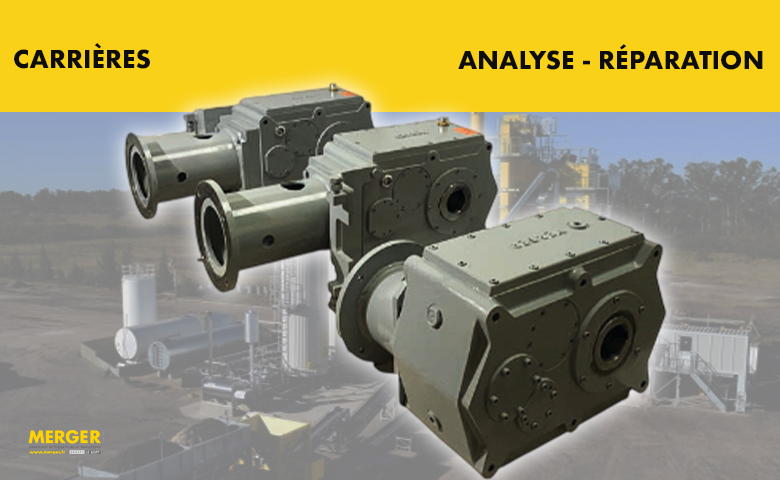
Therefore, with a view to preventing future problems for the operator, we first intervened on site to carry out an analysis both in operation and when stopped, and to check the mechanical condition of the equipment. After validation of the diagnosis , three speed reducers, each weighing 450 kg empty, were sent to MERGER 's workshops for refurbishment.
Understanding the role of speed reducers in an asphalt mixing plant
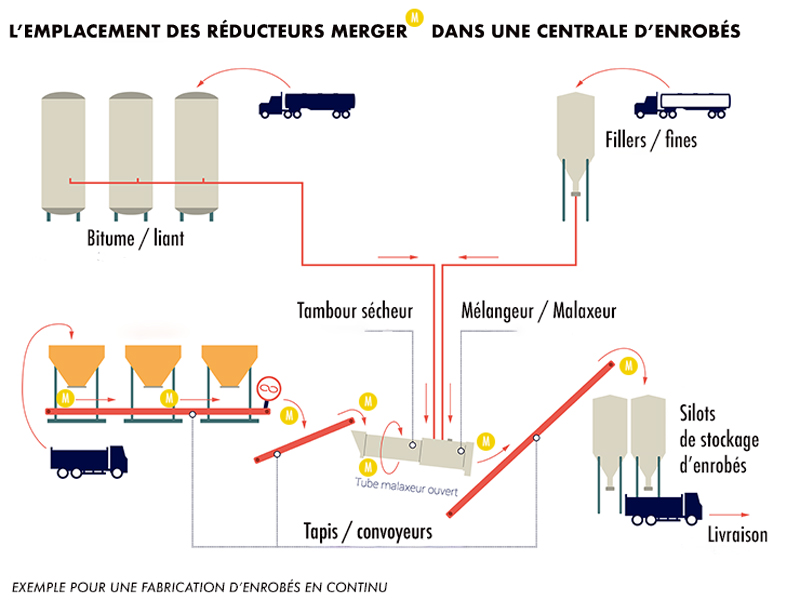
General structure of an asphalt plant
Regardless of the type of operation (continuous or discontinuous), an installation generally includes:
-
An area for storing aggregates and feed hoppers (pre-dosers).
-
Conveyor belts ensuring the continuous transfer of materials.
-
A drum dryer (the rotating “oven”).
-
A mixer containing hot binders and aggregates.
-
Bitumen tanks and a filtration/storage system for fillers (dust/mineral flour).
-
Temporary storage silos prior to delivery.
Operation of the asphalt plant
An asphalt plant produces road surfaces (hot, warm, or cold mix) by combining aggregates and bitumen. Plants typically need to meet the demands of all types of construction projects and produce a variety of products. The entire process relies on a kinematic chain where mechanical reliability is paramount to prevent unplanned downtime.
- The materials needed for the manufacturing asphalt is brought to the drum dryer by tapis conveyor.
- Drying takes place between 170 degrees (without recycled materials) and 400 degrees (with 60% recycled materials).
- The materials are then mixed with the bitumen in the mixer.
- Once manufactured, the asphalt mixes are conveyed to temporary silos while awaiting loading for delivery.
Where can speed reducers be found in an asphalt plant?
We can find speed reducers on several types of equipment in this type of installation:
- Transfer and handling systems carpets conveyors under the hoppers and towards the drum require reducers to drive the belt. In batch power plants, bucket elevators They use generally more massive reducers to lift the hot aggregates towards the tower.
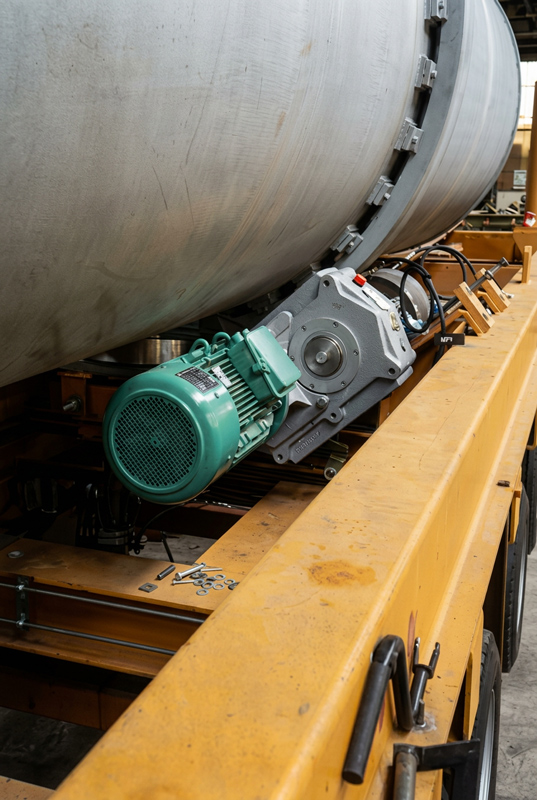
- The drying drum The drum, the thermal and mechanical heart of the site, raises the temperature of the aggregates between 170 ° C (without recycling) and 400 ° C (with up to 60% recycled materials). This cylinder, weighing several tens of tons, rotates continuously thanks to reducers high torque (coaxial, bevel gear or parallel shaft depending on the configuration) driving the assembly.
- The mixer Whether integrated into a continuous or discontinuous system, it mixes the hot viscous mass using geared motors to prevent stalling.
On-site and workshop services performed by MERGER
The challenge was not to replace an isolated part identified as defective, but to determine the actual condition of the gearboxes and which parts needed to be replaced to allow them to continue their service.
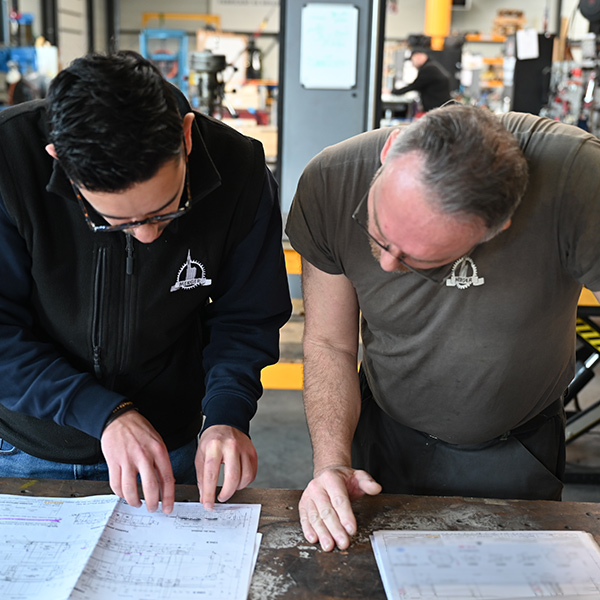
That is why, initially, our teams went to the asphalt plant to carry out a diagnosis of the equipment in situ , before its dismantling.
On site, our teams carried out the following: gathering information from the client; taking photographs and videos; analyzing the gearboxes in operation ; analyzing them while they were stopped ; opening access panels; performing an internal visual inspection and endoscopy when possible. This information tells us precisely how the equipment behaves before dismantling it.
All the information gathered was recorded in a site visit report sent to the client. Repair needs and proposed improvements were then submitted for approval.
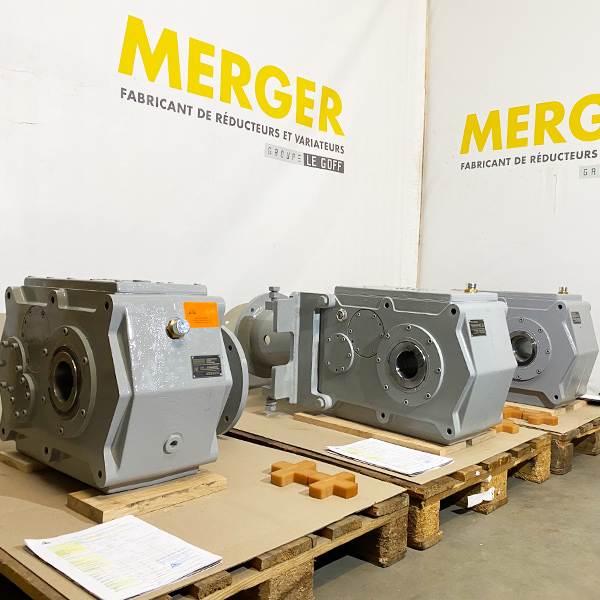
The old but usable gearboxes are being refurbished.
The equipment in question consists of reducers from the UNIMERGER range :
- 1 × UPA 200-3, dating from 1986; reduction report of 28
- 2 × UCA 200-3, dating from 1993; reduction report of 39
These are gearboxes equipped with cast iron casings. Their age explains in particular their design and their mass: approximately 450 kg empty.
On the UPA 200-3 gearbox , MERGER notably replaced the low-speed (LV) output gear . This work included the pinion, gear , key , hollow output shaft , and its key. Several components were also replaced due to wear, namely bearings, seals, and screws.
On the first UCA 200-3, MERGER replaced the low-speed gear assembly , consisting of the shaft pinion and the low-speed gear. MERGER also performed a metallization of the seal surface on the high-speed shaft.
This is an economically attractive solution because rather than systematically replacing the shaft, metallization allows a damaged bearing surface to be repaired in order to restore the characteristics necessary for the operation of the joint.
Finally, on the other UCA 200-3, we found that some internal components were more deteriorated than expected. Therefore, the MERGER workshop teams replaced the medium-speed and high-speed bevel gears.
This is a good example of the importance of a complete diagnosis : the actual condition of the components was only fully known after the reducer was opened.
The overall timeframe allowed Dijon Enrobés to anticipate its shutdown phases.
The service also had to meet a strict deadline . The operation took 14 weeks (10 for spare parts, 4 for the repair) and was planned to facilitate management for the operator. In other words, MERGER didn't just provide a technical solution: the entire service was organized to allow the client to plan the downtime of their equipment.
There is a significant number of MERGER gearboxes in asphalt plants. They are mainly found on ERMONT ( now FAYAT ) machines installed in the 1980s and 1990s.
For this sector, MERGER has developed specific skills in order to provide solutions that meet the constraints of operators and maintenance managers of asphalt plants:
- Diagnose before you repair: MERGER intervenes directly on site to observe the equipment in its real environment, in operation and when stopped.
- Understanding and assessing old equipment: The three gearboxes date from the 1980s-1990s and MERGER has the plans. Their restoration requires knowledge of their design and the ability to precisely identify the components to be replaced.
- Repair rather than systematically replace: Targeted replacement of gear pairs, shafts, bearings, seals or other components allows the housings and still usable parts to be preserved.
- Adapt the repair to the actual condition of the equipment: Disassembly can reveal damage that was not visible during the initial inspection. This is what happened on one of the UCA 200-3s, for which the medium-speed and high-speed bevel gears were eventually replaced.
The project undertaken for Dijon Enrobés proves that it is possible to reconcile industrial performance with budgetary constraints. The choices made have ensured the reliable operation of the drying drum. As a result, the company minimizes the risk of service interruptions without increasing its maintenance costs. Dijon Enrobés now has an efficient production tool, ready on time to support its future business volumes.