
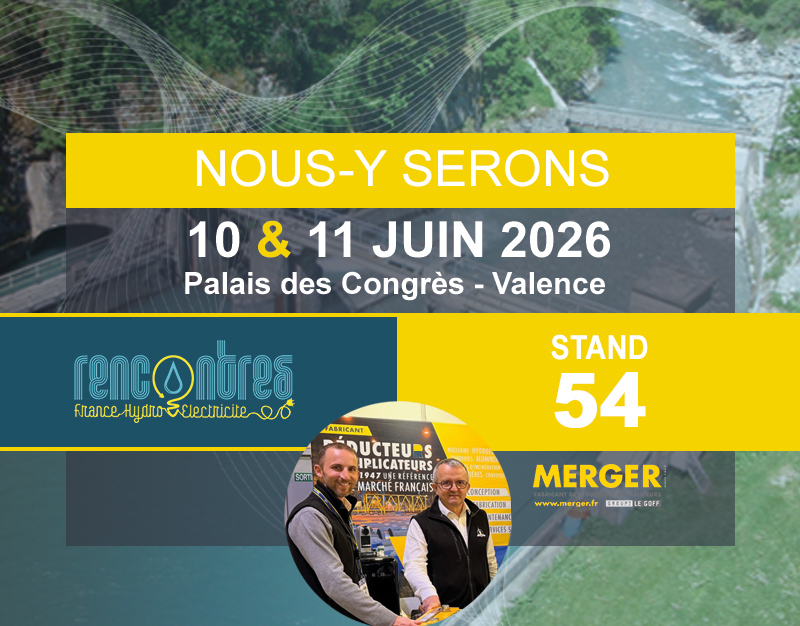
On June 10th and 11th , the small and medium-sized hydropower ecosystem will gather at the France Hydro Electricity Meetings at the Valence Convention Center. Addressing the challenges of availability and performance of your facilities, the MERGER team will be present to share its technical expertise and practical solutions.
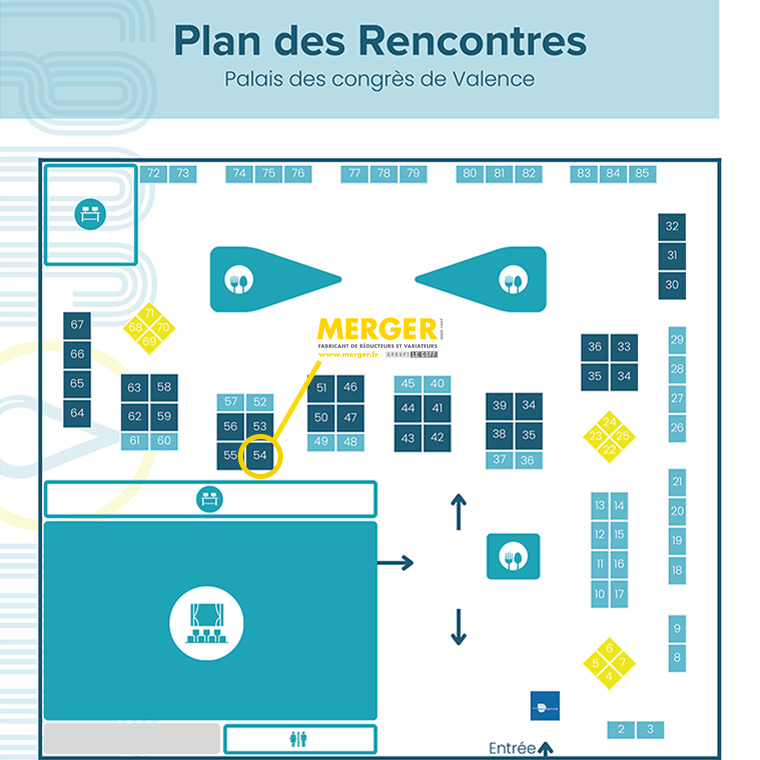
You can find us at booth 54.
Among the topics we can discuss on site, we propose three questions to assess your facilities:
Your screening equipment:
Environmental regulations, flood peaks: are your trash racks sized to meet the new constraints?
Hydroelectric power plants are subject to increasingly stringent environmental regulations (such as the Water Framework Directive in Europe). At the same time, to accommodate downstream fish migration , operators must install fine screens (sometimes with spacing of only 15 to 20 mm between the bars) to prevent fish (eels, salmon) from being drawn into the turbines. However, a fine screen mechanically necessitates much more frequent and robust cleaning than before. This is why older screens with wide mesh (50 to 100 mm) can no longer keep up and wear out prematurely.
Furthermore, river flow patterns have changed in recent years. Prolonged periods of drought followed by sudden and violent floods now carry significant volumes of sediment, leaves, plastics, and heavy debris (including wood and tree trunks). During these peak loads , the trash rack must operate at maximum capacity continuously. If the mechanical transmission is not properly sized or if the gears are worn, the system can jam or break down precisely when the operator needs it most.
That is why we support operators in finding a solution that meets the increased production rate, resistance to fatigue and protects the drivetrain.
The mechanical audit:
What is the benefit of a mechanical audit of your hydroelectric installation?
Waiting for a temperature rise or a suspicious noise is tantamount to experiencing mechanical failure during peak production. An audit allows for the detection of pitting (surface fatigue of the gears) or bearing wear before the variable speed drive seizes up during the season, and verifies whether the current system is still adequate for the water flow rate.
It is particularly important to ensure that the torque is distributed evenly across the entire width of the teeth. Indeed, poor contact indicates misalignment or deformation of the housing, causing premature wear.
Our audit provides a criticality assessment. It allows you, for example, to plan unit outages rationally, anticipate the replacement of consumables (bearings, seals) and ensure the availability of facilities during periods of high activity.
The efficiency of your installation:
How can you improve the efficiency of your installation? Are you generating the maximum power allowed under your contract?
Every kilowatt of mechanical energy lost through friction or vibration between the turbine and the generator is a kilowatt that will not be billed . In hydroelectric installations, slight misalignments or the gradual wear of the gear profiles in the speed multipliers and variators create silent efficiency losses. In the long run, these deviations can prevent the installation from reaching its rated power and saturate its grid injection contract , directly impacting the return on investment.
MERGER will be available to listen to you at the France Hydro-electricity meetings to discuss the mechanical levers that directly impact the yield of the operation.
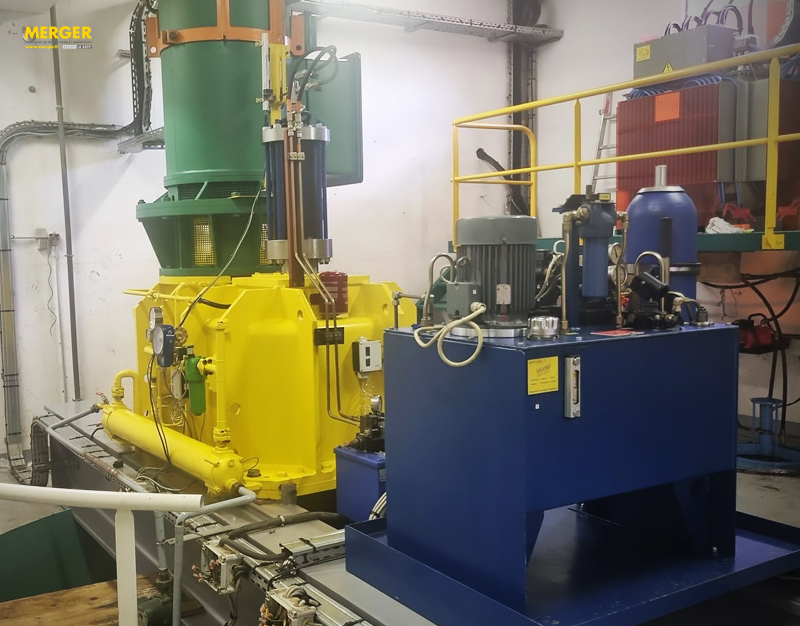
ALSO FIND OUR ARTICLE ON BEST PRACTICES FOR MAINTAINING SPEED MULTIPLIERS:
Oil, vibrations, analysis: how MERGER supports you in increasing the lifespan of your equipment.
Would you like to learn more about our services for the hydroelectric sector? Contact our dedicated team via our contact form.