
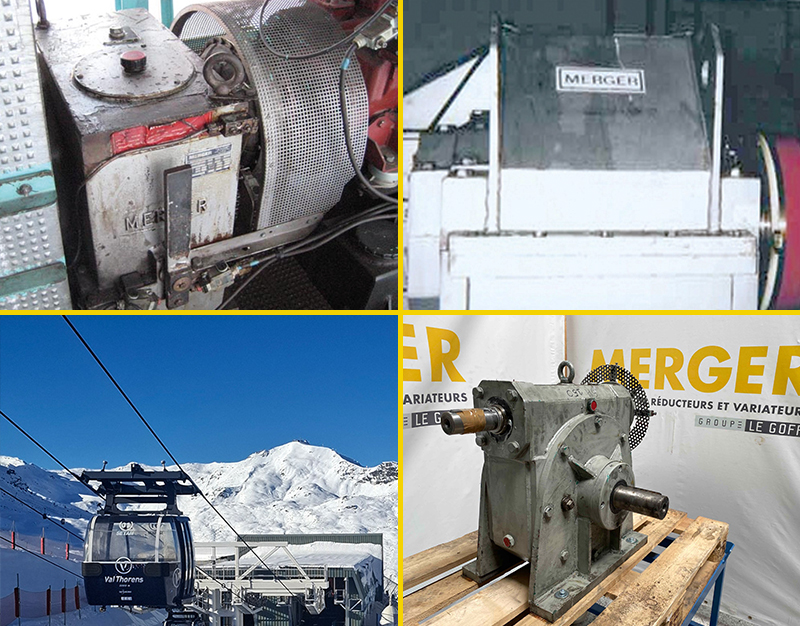
Ski lifts represent one of the most demanding environments for power transmission. Passenger safety relies on a kinematic chain where each component must guarantee absolute reliability under extreme cyclic stresses. Drawing on its long-standing expertise in mechanical engineering, MERGER supports ski resort operators, such as Val Thorens, in ensuring the reliability and maintenance of these strategic equipment systems and provides further insight into the workings of this unique mechanism.
How a ski lift works and the role of the gearbox
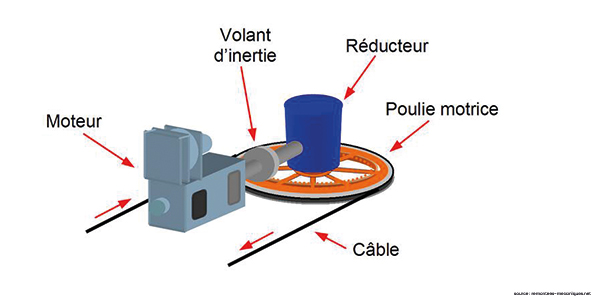
The fundamental principle of a ski lift rests on a simple yet demanding physical equation. For an electric motor to be efficient and compact, it must rotate at a high speed, generally between 1000 and 1500 revolutions per minute. Conversely, to ensure comfortable and safe transport, the cable of a chairlift or cable car must move at a constant speed, often between 3 and 6 meters per second. This constraint necessitates a slow rotational speed for the drive pulley , rarely exceeding 20 revolutions per minute.
This is where the speed reducer comes in , the true heart of the drive station. Its role is twofold: it ensures the speed reduction while simultaneously multiplying the torque inversely. Without this component, the electric motor would never have the rotational force (torque) necessary to pull the load from the line when stopped or to compensate for the effect of gravity on the vehicles going uphill. In installations like chairlifts, the speed reducer guarantees this quiet power that allows a constant operating speed to be maintained regardless of the seat occupancy.
Typology and location of transmission components
The architecture of a drive station is structured around two main axes: the high-speed shaft and the low-speed shaft. The gearbox is invariably located between these two segments. The service brake is generally found on the high-speed shaft, at the motor output. The drive pulley , often equipped with its own safety brakes known as "pulley brakes," is mounted on the low-speed shaft, at the gearbox output.
Several reduction technologies exist, each suited to the specific requirements of different types of equipment. Parallel or right-angle shaft gearboxes are classic mechanical designs, valued for their robustness and ease of maintenance in medium-power applications. However, for high-stress installations such as cable cars, epicyclic (or planetary) gearboxes are preferred. This technology allows for the transmission of massive torques within a compact volume thanks to the load distribution across several planetary gears rotating around a central pinion. This compactness is a significant advantage for integration into modern drive stations where space is at a premium.
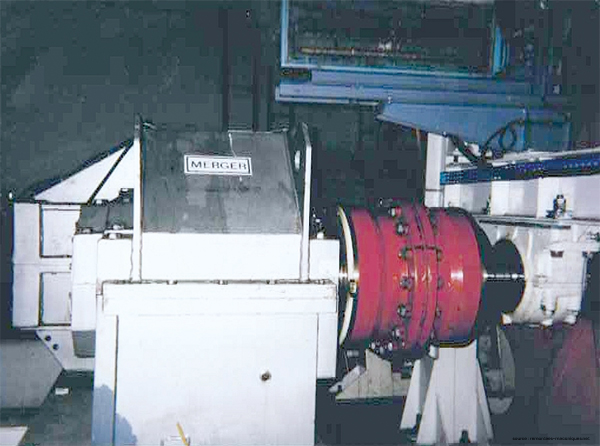
Emergency motor: the Merger mechanical gearbox allows coupling to the reduction gear
Regulations governing cable transport mandate absolute safety, meaning that the installation must be able to be evacuated even in the event of a total failure of the main system (power outage or motor failure). To meet this requirement, each device is equipped with a backup drive system , sometimes a combustion engine or sometimes a hydraulic one.
MERGER gearboxes or transfer cases play a crucial role in this redundancy scheme. Unlike the main gearbox, which operates continuously, the backup gearbox is a coupling device . It engages the auxiliary motor with the drivetrain. In some cases, this gearbox bypasses the main gearbox if it fails, by directly engaging a toothed ring gear attached to the pulley. These components are critical: they must be able to remain stationary for months and then operate instantly under maximum load to transport passengers back to the station.
Maintenance and vigilance: the life of the mechanism in an extreme environment
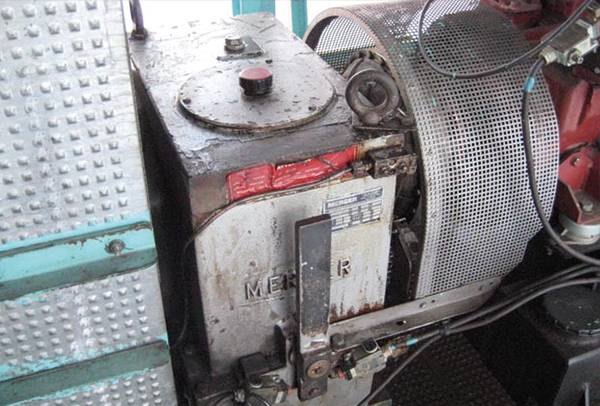
The longevity of a mechanical transmission at high altitude depends not only on its initial robustness but also on rigorous maintenance. MERGER 's work in high-altitude resorts like Val Thorens highlights specific areas requiring attention. The primary enemy of the transmission is condensation. The significant temperature fluctuations between day and night cause water to form inside the casings, which degrades the oil's properties and can lead to bearing corrosion.
Precision maintenance rests on several pillars. MERGER carries out on - site inspections as part of this.
Vibration analysis is the most revealing: it allows us to listen to the "signature" of the gears and bearings. A change in this signature often indicates pitting ( micro-abrasion of material on the teeth) or the beginning of bearing fatigue.
Controlling backlash , or play between teeth, is also crucial to avoid shocks during reversing or sudden stops.
Finally, MERGER offers a solution to obsolescence: through reverse engineering , it is possible to remanufacture identical gears or shafts for equipment whose original manufacturers have disappeared, thus extending the lifespan of the installations while guaranteeing their compliance with current safety standards. The company still possesses the original blueprints , which were moved from Strasbourg to its current workshop in Corbas.
For a ski lift operator , power transmission represents a major economic and safety challenge. A failure of the main gearbox results in a complete shutdown of the lift, directly impacting commercial operations. The pursuit of reliability leads to a preference for robust equipment capable of withstanding continuous operation throughout the winter season.
Sources: remontes-mecaniques.net